Wedding guest book prompts: 25 questions that get more personal messages
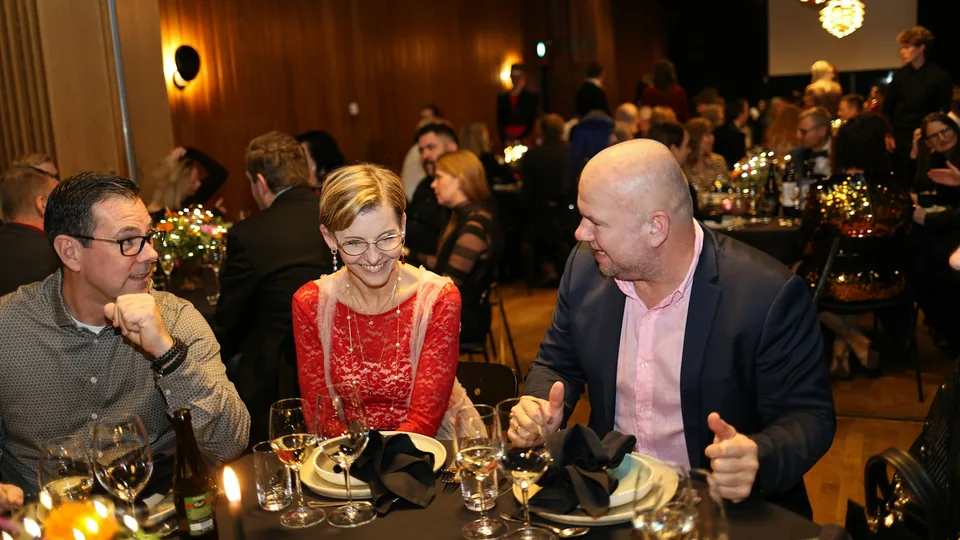
There's a moment, weeks after the wedding, when you sit down to read the guest book. And you discover that twenty different people wrote practically the same thing: "Congratulations, wishing you all the best," "May you be very happy," "You make a beautiful couple." None of it is untrue or badly written. It simply doesn't tell you anything you didn't know.
The problem is almost never the guest. It's the question. When all the table says is "Leave us a message," the brain reaches for the fastest, safest formula. When it says "Tell us about the day we met," the person has to go find a specific memory. That's where the things you'll want to reread ten years from now show up.
This article is for you, the hosts: how to choose that prompt. If you're looking for ready-made lines to write as a guest, see wedding guest book messages from guests and what to write in a guest book.
Why a good prompt changes the result
Writing in a wedding guest book is an awkward situation in miniature: people are standing, drink in hand, with five others waiting behind them and no idea how much is expected. Under those conditions, the default answer will always be short and neutral.
A specific question does three things at once:
- It shrinks the blank page. There's nothing to decide, only something to answer.
- It sets a tone. If the question is funny, the messages will be funny. If it's sentimental, they'll be sentimental.
- It prevents repetition. Everyone has a different story with you. Nobody has a different "congratulations."
There's a fourth, less obvious effect: the question tells the guest that their answer matters. That you aren't collecting signatures. You're collecting memories.
25 prompts, sorted by what you want to get back
Don't use them all. They're grouped so you can quickly find the one that fits your wedding and your people.
Shared memories
The most rewarding kind: almost everyone has an answer, and almost none repeat.
- What's your first memory with us?
- Which day with you do we always remember, and you might not even suspect?
- Tell us something we did together that we should never do again.
- When did you think "these two are going to end up together"?
- A place we have to go back to with you.
How they met the couple
These work especially well when your two groups of friends don't know each other. Reading them later is like redrawing the map of your lives.
- How did you meet [name]? Tell it with all the details.
- What was your first impression of [name]? Be honest.
- When did you meet the other one, and what did you think?
Advice, without the sermon
Wedding advice turns sappy fast. The fix is to ask for something specific instead of general wisdom.
- One small habit that's worth keeping as a couple.
- What do you do at your house when you're both in a bad mood at the same time?
- A cheap plan that can save a bad Sunday.
- Something you learned late about living with someone.
Predictions
These age the best: ten years on, rereading them pays off.
- Where do you see us in ten years?
- Which of us will give up first while assembling furniture?
- Which of our habits do you think will never be fixed?
- How many plants do you think will survive in our home?
Funny moments
- The story about us you tell when you want to make someone laugh.
- What phrase do we say too much?
- Give us a nickname that will haunt us.
Messages for your future selves
- Write something we should read on our first anniversary.
- What exactly should we remember about today?
- A wish for us twenty years from now.
A photo and its story
If your book takes pictures, this is the category you'll enjoy most afterwards, because a photo with no context gets forgotten and a photo with a sentence doesn't.
- Add a photo of you from tonight and tell us what was going on.
- Show us an old photo with us.
For anyone who doesn't know what to write
There are always guests who find writing hard. Give them an easy way out and they'll take part anyway.
- Three words to describe today.
And if your book lets guests record a voice note, the spoken version of any of these prompts tends to unlock exactly those people: telling something in twenty seconds is far more comfortable than writing it. Grandparents and kids appreciate it most.
Different prompts for different guests
No need to overcomplicate it, but if you can segment a little, the result improves.
Family does well with anything that looks back: "What was [name] like as a kid?", "What would you like them to inherit from this family?" These are answers nobody else can give you later.
Close friends do well with anything that looks inward: stories, nicknames, specific eras. Here the prompt can be as specific as you like, because they have the context.
Coworkers and guests who aren't as close do better with something kind and contained: "Three words for today" or "a wish." Asking them for intimacy makes them uncomfortable, and they end up leaving the generic message you were trying to avoid.
The rule that really matters: one single prompt
It's tempting to put a pretty list of ten questions on the table. Don't. A guest with ten options in front of them and a drink in their hand doesn't choose. They walk away.
What works is one main prompt, the same for everyone, and at most one alternative in case it doesn't fit. You gain two things: nobody has to decide anything, and all the answers can be compared when you read them one after another, which is where the fun is.
If you're struggling to choose, there's a simple trick: keep the prompt whose answers you most want to read. Not the most original one. The one you're most eager to hear.
A reasonable alternative if you can't bear to give up variety: change the prompt by time of day. One during cocktail hour and another on the dance floor, for example. But only if someone is going to make sure it happens. Otherwise it stays an idea.
Where to put the prompt so it gets read
The prompt only works if it appears right before the guest writes. These are the natural places:
- On the card or sign with the QR code. The best spot: the prompt takes up one big line and the rest is the code. Instead of "Sign our guest book," "Tell us how you met us." On where to physically place those cards, see QR codes on wedding tables.
- In the event's welcome note. If you use a digital book, that note is the first thing a guest sees when they open the link, so it's where the prompt pays off most. It's also where you can explain in one line that they can leave a message with a photo and, if you turn it on, a voice note.
- In the text or group chat message, when you share the link before or after the wedding. A "How did you meet us?" in the message itself gets answers from people who would otherwise have opened, looked and left.
- On the venue signage, if you have a board at the entrance or by the photo backdrop. Repeating the same line is enough. Don't invent a second one.
One detail people overlook: use the same prompt everywhere. If the table says one thing and the link says another, the guest hesitates and ends up writing the usual.
How this looks in a digital guest book
With a paper book, the prompt goes on a sign and that's it. With a digital one, you can write it into the event itself: the guest scans the QR code, reads the prompt on screen and answers right there, without installing anything or signing up. They write their answer and can attach a photo from the night or, if you turn it on, record a voice note; it all stays together under their name.
There's a practical advantage for our purposes: you can change the prompt up to the last day, even during the wedding, without reprinting anything. If the format interests you, it's explained in full in the digital wedding guest book, explained and in how it works.
Once you've decided, create your book for free, write your prompt in the welcome note and test it by sending yourselves the link. It's the best way to see whether the prompt invites an answer or sounds like a form. You can also see the wedding version on the digital wedding guest book page.
Three mistakes that ruin a good prompt
- Asking for too much. "Write us a letter" is lovely, and almost nobody does it. The prompt has to be answerable in two minutes, standing up.
- Asking something that makes people perform. "What does love mean to you?" makes people compose. "How did you meet us?" makes them remember.
- Switching tone halfway. If your wedding is relaxed and the prompt is solemn, the answers come out forced. The prompt should sound like the two of you talking.
The prompt is half the battle. The other half is getting guests to it, which is covered in how to get guests to sign your guest book. Choose one, write it the way you'd say it out loud and put it where guests see it right before they write. That's nearly everything it takes for a guest book to stop being a list of congratulations and become something you reread.
Related articles
Digital guest books for wedding planners: how to offer one to your couples
An extra that adds no logistics to the wedding day if you plan it well: who creates it, when to set it up, how to show it on a screen and which plan suits each couple.
7 min
Messages, photos and voice notes: what your wedding keepsake looks like when guests give all three
A message tells you what someone thinks, a photo shows how it felt and a voice note gives you their voice back. Here is how your wedding keepsake changes when guests leave all three.
8 min
How to get guests to sign your wedding guest book
Participation is a matter of friction and timing, not nagging. What actually moves the needle before, during and after the wedding.
8 min